
What is French Filigree?
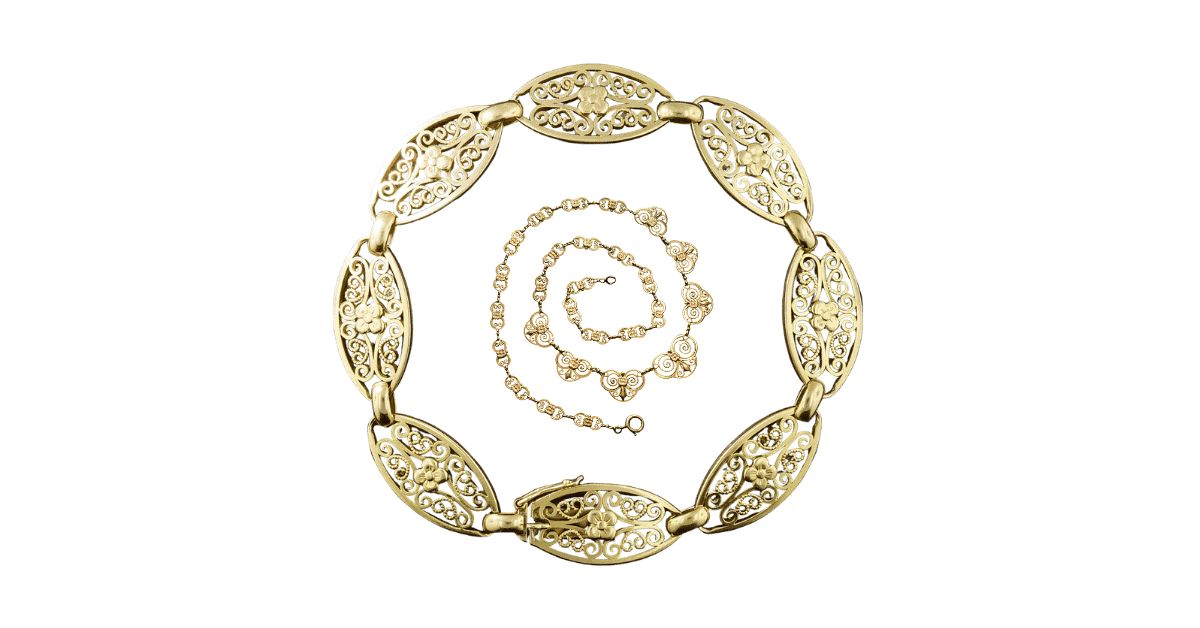
French filigree, also known as Filigraine, is a style built from fine threads of gold or silver, twisted, curled, and soldered into lace-like patterns. What sets the French version apart from filigree made elsewhere is a lighter, more open touch, thinner wire, more negative space, and a preference for symmetrical floral and scroll motifs that trace back to Parisian workshops of the 1800s.
This guide covers everything you need to know about French filigree, so you know exactly what you’re looking at and how to wear it. We’ll cover the key historical facts of French filigree, 7 ways to style it in 2026, the main types you’ll find on the market, and a short list of necklaces, rings, and other pieces you should add to your collection.
Everything below is the latest information as of September 2026.
Key Historical Facts of French Filigree
Filigree itself is not a French invention. The technique traces back roughly 3000 years to goldsmiths in Mesopotamia and Egypt, who twisted fine wire into pendants and dagger sheaths.
What became distinctly French happened much later, when Parisian jewelers picked up the craft, refined it, and folded it into the country’s fashion identity across several very different centuries.
Here are some interesting facts about how French filigree has shifted in shape over the centuries, from royal courts to post-war goldsmith shortages.
- Filigree work reaches back roughly 3,000 years, with the earliest known pieces dated to around 2,600–2,500 BC.
- French fashion adopted filigree as a mainstream jewelry style starting in the late 1600s, running as a recognized trend for roughly 200 years into the 1800s.
- After the Napoleonic Wars, gold became so scarce across the continent that French goldsmiths developed cannetille, a filigree offshoot that stretched a small quantity of metal into large, sculptural pieces, with the style peaking around 1830.
- French filigree saw a second wave of mainstream popularity in the 1960s, when the technique resurfaced in French fashion circles nearly a full century after its Napoleon III-era peak.
- Countries known for their own filigree traditions today include Portugal, Cyprus, Malta, India, and Greece, all of which developed styles distinct enough from the French approach to spot with a trained eye.
7 Modern Ways to Style French Filigree Jewelry in 2026
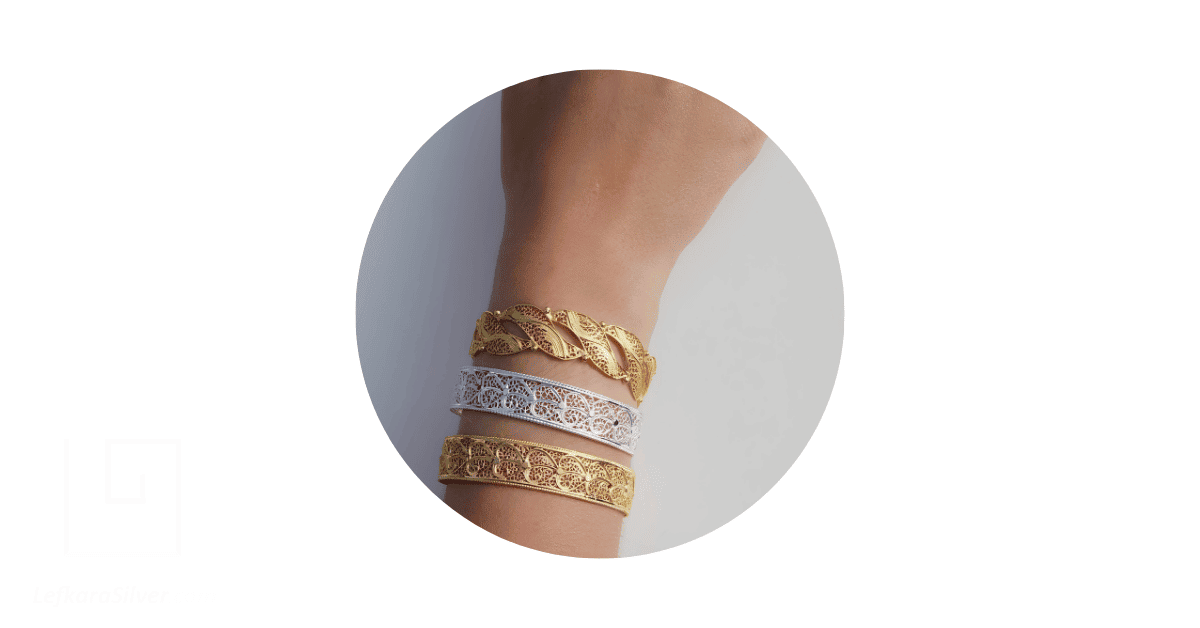
French filigree has survived centuries of changing taste. A brooch that once pinned a Regency shawl looks just as at home on a linen blazer today, and a pair of cannetille earrings pairs as easily with a silk gown as with jeans and a plain tee.
The trick to wearing it well in 2026 is learning a few practical pairing habits that let the filigree get the attention.
1. Let One Piece Carry the Whole Look
Filigree is busy by nature, so the easiest styling rule is restraint everywhere else. A single statement filigree cuff or collar can replace three or four smaller accessories without the outfit looking under-dressed. Pair it with solid-color clothing and skip additional jewelry in the same body zone.
Keep hair and makeup simple and it’d still be divine when a large filigree piece is the focal point.
2. Mix Antique Filigree With Contemporary Basics
Pair with something distinctly modern, like a plain gold band, a minimalist watch, or a structured blazer with clean lines. The contrast between the piece’s lacy, hand-worked details and the surrounding simplicity makes both look more intentional. Save the fully vintage-styled outfit for special occasions, and let filigree do double duty as an everyday anchor piece the rest of the time.
3. Layer Filigree Rings for a Stacked Effect
Filigree rings scale down beautifully, which makes them ideal for stacking. Two or three slim filigree bands worn together on one finger, or spread across adjacent fingers, create texture, and they don’t even look bulky.
You can mix filigree rings with a cannetille-style rosette ring for contrast in scale, and keep metal tones consistent so the stack feels intentional and not like a random pile.
4. Use Filigree Earrings With Shorter Hairstyles
Filigree earrings are usually lightweight despite their appearance. A bob, pixie cut, or any style that leaves the neck and ears visible is the ideal fit for chandelier-style filigree drops, since there’s nothing blocking the openwork pattern from view.
Choose drop length based on jaw shape: shorter, rounder filigree studs suit angular faces, while longer teardrop or chandelier designs elongate a rounder face. Either way, the piece should move slightly when you turn your head.
5. Wear Filigree With Natural, Textured Fabrics
Filigree’s lace-like structure has a natural affinity for fabrics with their own texture; raw silk, linen, tweed, and unbleached cotton all complement the handmade look of twisted wirework far better than glossy, synthetic fabrics do.
This pairing is particularly effective for daytime and workwear settings.
6. Choose Sturdy Filigree
Filigree work is so labor-intensive, so, pieces made with it tend to hold sentimental and resale value better than mass-produced designs. This makes filigree engagement rings, christening jewelry, and family heirloom pieces a practical choice as well as a stylistic one.
A well-made filigree ring purchased today can be worn and passed down for generations, much like many surviving Georgian and Victorian pieces that still circulate in the antique market today.
7. Wear Filigree With Minimalist Layering Chains
A single fine chain layered behind or in front of a filigree pendant adds length and movement without competing with the pendant’s detail. Keep the second chain thin so it visually recedes and lets the filigree piece stay the focal point.
This works particularly well with cannetille-style pendants, since their raised, three-dimensional shapes already stand forward from the neck; a plain chain layered just behind it adds depth to the overall look without adding visual noise.
Avoid layering two textured or patterned chains together with a filigree piece, since the eye needs at least one plain element to rest on.
The Main Types of French Filigree
French filigree is a family of related wirework methods that developed and overlapped across different periods, each with its own construction method, level of dimension, and typical use.
The main ones include:
Openwork filigree: This is the purest form of the technique. For this type of filigree, fine wires are twisted, curled, and soldered directly to one another with no metal backing at all. The structure holds together because the wires are fused at every point of contact, with slightly heavier wires forming the outer frame and finer ones filling the pattern inside it.
This is also the most technically demanding version to produce. A single miscalculated joint can cause the whole structure to collapse during soldering, which is part of why hand-made openwork filigree is expensive.
Metal-Supported (Backed) Filigree: In backed filigree, the twisted and shaped wire is soldered to a solid metal sheet. This construction method is easier to produce and considerably more durable, since the wire pattern is fully supported rather than free-floating.
Backed filigree loses some of the light-through-shadow effect of openwork, but it opens up design options that pure openwork can’t achieve, including combining the wirework with engraving, enamel fill, or gemstone settings directly on the backing plate.
Cannetille: This is the technique most closely associated with French filigree’s most celebrated period, roughly 1815 to 1840, when a scarcity of gold across post-Napoleonic Europe pushed goldsmiths to find ways of making a small amount of precious metal look far more substantial. The name comes from a French embroidery term for tightly spiral-wound metallic thread.
Cannetille is deliberately three-dimensional and raised off the surface of the piece, giving it a sculptural, almost architectural quality. Coin-inexpensive colored stones were commonly set into cannetille pieces, since the labor-intensive wirework itself was already the showpiece and didn’t need diamonds to look luxurious. A well-preserved cannetille piece from the 1820s or 1830s is now considered one of the more valuable categories of antique gold jewelry, precisely because the technique is so rarely reproduced by hand today.
Plaited and Twisted Wire Filigree: This method braids or twists two or more wires together before shaping them into the final pattern. The resulting thread has a rope-like texture that catches light differently than a smooth single wire, adding a secondary layer of detail to the piece.
Plaited wire was frequently used as the structural frame in openwork filigree, since a twisted or braided wire holds its shape under tension better than a plain one.
Must-Have French Filigree Necklaces, Rings & More
If you want to build a filigree collection, French pieces should be at the top of the list. France has run one of the oldest hallmarking systems in the world, dating back to 1275, and that long history of regulation is part of why French filigree carries so much weight with collectors; every piece tells you something concrete about its metal content and origin, not just its looks.
Below is a breakdown of the five pieces you should definitely hunt down first:
French Filigree Necklace
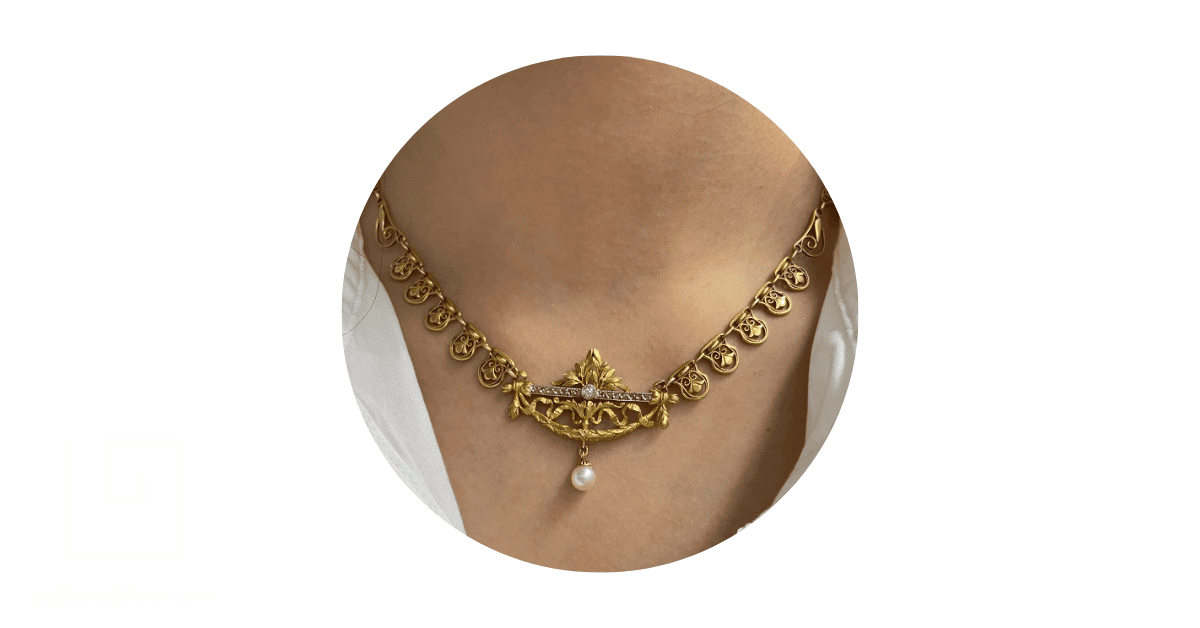
Many neck pieces from the Belle Époque and Art Nouveau periods feature floral and scroll motifs, as nature-inspired design was dominant in French decorative arts at the time.
Symbolically, floral filigree work was tied to romance, remembrance, and femininity, which is why so many surviving pendants were made as gifts marking engagements or births.
French Filigree Earrings
Earrings were where French filigree artisans could afford to take the most risk, since the smaller scale meant less material cost even when the wirework got elaborate. Chandelier and drop styles are especially common, with tiers of filigree “baskets” or rosettes cascading below the earlobe, each one hand-formed rather than stamped from a mold.
Many antique French filigree earrings combine the open wirework with a single small stone set at the center as a focal point.
French Filigree Chains
Chains might seem like the simplest category, but French filigree chainwork is where you see the technique applied with the most repetition and precision, since every link has to match the next.
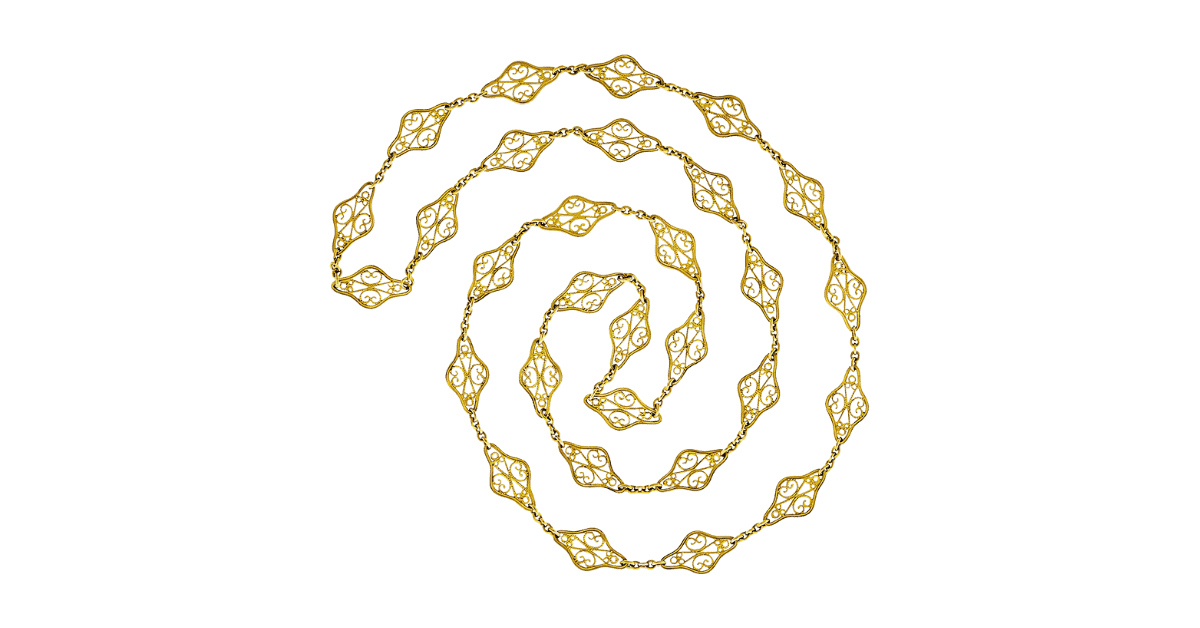
A filigree chain is built from small twisted-wire segments soldered into open, lace-like units, then connected in a continuous run.
These chains rarely carry heavy symbolism on their own, but they were frequently used to suspend religious medals or mourning lockets, so the chain itself became part of a larger sentimental piece rather than just a standalone statement.
French Filigree Ring
Filigree rings are arguably the category where French makers pushed the technique hardest, as a ring has to hold its shape under daily wear while still showing off open, airy wirework.
Designs often center on a raised gallery, built entirely from coiled and looped wire, sometimes finished with tiny granulated beads at the intersections for added texture.
French Filigree Bracelet
Bracelets were also a common site for sentimental engraving on the interior, because the wider surface area of a bangle or panel link gave more room for initials or dates than a ring or earring would allow.
A bracelet with consistent wire gauge across its entire length is a strong sign of quality hand craftsmanship, as maintaining an even wire thickness through dozens of coils is one of the harder parts of the filigree technique to get right, and it’s exactly where cheaper reproductions tend to fall short.
Tips for Identifying Authentic Vintage French Filigree
With the rise of imitations, here’s what to check when buying a French filigree jewelry:
- Hallmarks first: Look for the eagle’s head mark on gold pieces. A missing or blurry hallmark on what’s sold as an antique piece is a red flag.
- Check the maker’s mark: Genuine French pieces typically carry a small lozenge-shaped stamp with the maker’s initials alongside the fineness hallmark. One mark without the other should raise questions.
- Inspect wire consistency: Hand-formed filigree has small, natural irregularities in the wire twists, while cast or stamped imitations tend to look too uniform and slightly flattened up close.
- Look at the back: Authentic filigree is usually open and airy on the reverse, since the technique relies on soldered wire rather than a solid backing. A solid metal back on a piece marketed as filigree often signals a cast reproduction.
- Weigh it in hand: Real filigree feels lighter than its visual size suggests, because it’s built from wire rather than solid metal.
- Use magnification: A 10x loupe on the clasp, inner ring shank, or earring post will make hallmarks and solder joints far easier to read than the naked eye.
- Match sets carefully: For earrings or multi-piece sets, compare wire density and pattern spacing between pieces.
- Ask for provenance: Sellers who can point to an estate history, prior appraisal, or documented sale record add real weight to a piece’s authenticity, on top of what the hallmarks alone can tell you.
French Filigree vs Portuguese Filigree: What’s the Difference?
Portuguese filigree is one of the most recognized branches of this craft, with a history that stretches back to the Phoenician and Roman traders who brought goldwork to the north of Portugal, and pieces made with this technique that appear in the archaeological record dating back roughly 2,000 BC, with the craft resurfacing during Muslim rule of the peninsula around the 8th century AD.
For more on how far back filigree really goes and which origin claims actually hold up, you might want to look at filigree’s real origin story.
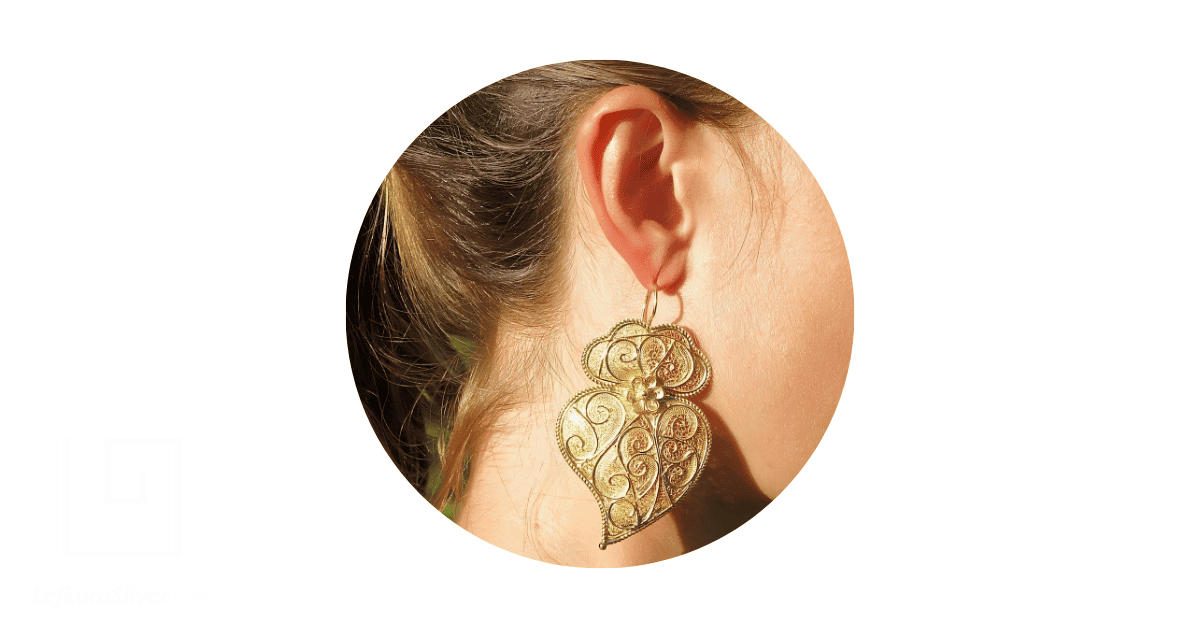
The biggest difference between French and Portuguese filigree comes down to timing, material, and purpose. Portuguese filigree grew out of folk and religious life. Pieces like the Viana heart, queen’s earrings, and Viana beads were tied to specific customs, courtship rituals, and regional dress rather than high fashion.
The Viana heart itself was never originally a romantic symbol; Queen D. Maria I commissioned the first one in gold as an offering of devotion to the Sacred Heart of Jesus after the birth of a son, and that religious meaning stuck around for generations even as the piece became a love token.
French filigree, by comparison, developed as a fashion statement instead. The style entered the mainstream through fashionable European jewelry circles, with France driving much of that popularity from the late 1600s through the 1800s, well before it became associated with any single religious or regional custom.
So while both crafts share the same wire-and-solder foundation, Portuguese filigree is regional and symbolic, and French filigree is an evolution of fine jewelry fashion trends.
Why is French Filigree a Perfect Gift?
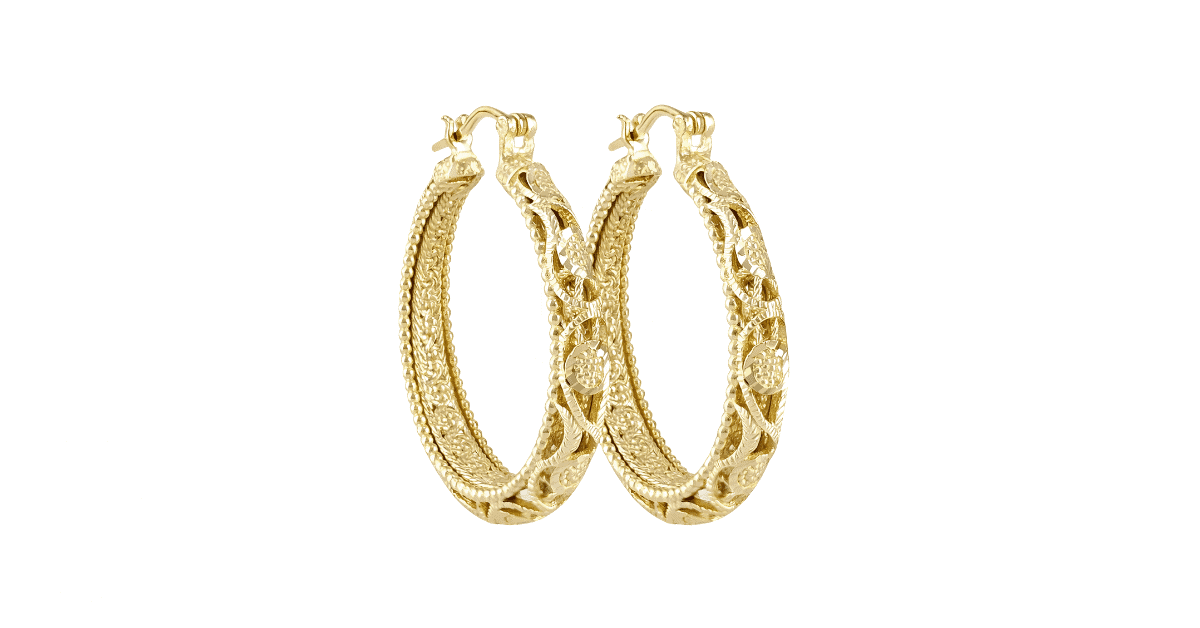
A piece of French filigree makes a deeply thoughtful gift because it carries a sense of history and human labor that mass-produced jewelry simply cannot match.
When picking out a gift, check for pieces that show the three-dimensional nature of the craft, such as brooches or earrings. A pair of antique-style filigree earrings, perhaps with small turquoise or seed pearl accents, is a perfect choice for someone who appreciates vintage charm. These gifts feel personal because they show you put effort into finding something that values craftsmanship over raw size or flashiness.
Prices for these pieces fluctuate based on age and the specific metal used. You can find silver filigree earrings or small pendants for a few hundred dollars, while 18-carat gold pieces from the 19th century can cost significantly higher prices at specialized auctions or high-end antique shops.
If you want something custom-made, Lefkara Silver can design a bespoke piece that feels like a family heirloom from the moment it is given.
French Filigree Care & Maintenance Tips
The longevity of a French filigree piece depends entirely on how you treat its delicate, lace-like structure.
- Clean with gentle tools: Never use harsh scrubbing brushes or abrasive pastes on filigree. Use a soft-bristled brush, such as a clean baby toothbrush, with warm water and a tiny drop of mild, pH-neutral soap. Gently pat the piece dry with a microfiber cloth rather than rubbing it, as rubbing can snag the fine wire loops and cause them to bend or snap.
- Avoid chemical dips: Stay away from commercial liquid jewelry cleaners, which often contain harsh acids. These cleaners can strip away the unique patinas that give vintage items their character, and they are notoriously difficult to rinse out of the complex, openwork crevices of a filigree mount.
- Store individually: Your filigree pieces easily hook onto other jewelry, so always store separately in a soft pouch or a padded box. This prevents it from getting crushed or entangled with heavier items that could warp its shape.
- Remove before activity: Take off your filigree rings or bracelets before doing chores, exercising, or applying perfume. Perfume and hairspray residue are the leading causes of tarnish on silver filigree, as these substances contain chemicals that react negatively with the metal over time.
Final Thoughts on French Filigree
Looking back, we covered the essential history of this craft, from its peak era to the modern ways of styling French filigree in 2026. We explored the differences between French and other regional styles, the best materials for both historical and current pieces, and why these items make such meaningful gifts.
From identifying authentic vintage finds to learning how to care for your filigree collections, you now have all the information you need.
Here are some key points to remember:
- French filigree is historically defined by its use of exceptionally fine wire, often reaching a fraction of a millimeter in thickness.
- Unlike generic jewelry, a well-made filigree piece relies on its own internal geometry for stability rather than heavy amounts of solder.
- Authentic vintage filigree is frequently found in lower-carat gold (14–18 carat) because these alloys provide the perfect balance of hardness and pliability for twisting.
- Cannetille is a distinct, related technique that adds a three-dimensional, spring-like quality to filigree, creating a look that mimics raised metal embroidery.
This content was last updated in September 2026. Follow our website, LefkaraSilver.com, to stay informed about new jewelry offers, news, and buying guides.